BookForge
Private beta — free during testing
Checking availability…

The publishing pipeline,
as a desktop app.

From discovery to distribution-ready files — orchestrated through one dashboard, powered by your own Claude account, with editor-in-control gates at every step.

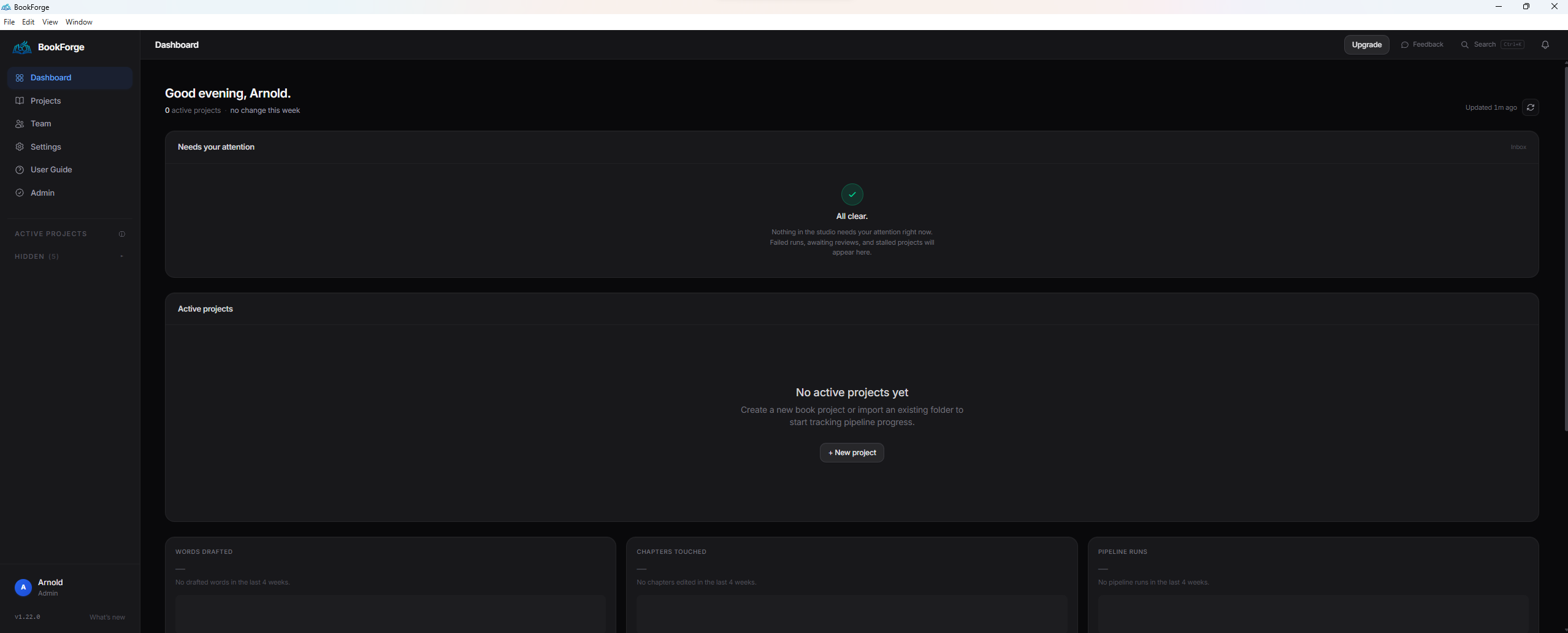
BookForge desktop app dashboard — sidebar with Dashboard / Projects / Team / Settings / User Guide / Admin navigation, a 'Good evening, Arnold' greeting, an empty 'Needs your attention' inbox, an 'Active projects' empty state, and Words drafted / Chapters touched / Pipeline runs metric panels.

BookForge dashboard · actual desktop app screenshot · not a render

One platform · Two ways to power it

Bring your Claude account.
Either kind.

BookForge runs every pipeline step through Claude. You bring your own Claude account — subscription or API key. We never touch your spend or stand between you and Anthropic.

Recommended

Your Claude.ai subscription

Sign in once with your Pro or Max account. Pipeline steps run against your subscription's usage limits — predictable monthly cost, no per-token billing, no surprise invoices.

  • Flat monthly cost via Claude.ai Pro or Max
  • OAuth sign-in via the Claude CLI
  • Best for full-book projects + heavy revision passes
Your Anthropic API key

Drop in your own API key from console.anthropic.com. Pay per-token at Anthropic's published rates — better if you want fine-grained spend control or you're running short experiments.

  • Pay-as-you-go, billed directly by Anthropic
  • Per-step cost insights inside the dashboard
  • Best for shorter projects + cost-sensitive workflows

Same product either way — every pipeline step, every gate, every export format works identically. Switch between billing modes from Settings → AI at any time.

Built for
  • Self-published novelists
  • Ghostwriters
  • Small presses
  • Translators
  • Trade authors on their next book
The flagship gate

Editor-in-control,
at every step.

Every audit step — fact-check, continuity, supervision, copyedit, galley proof, sensitivity, legal — lands in a Review Center. You approve, edit, or send back. The pipeline waits.

The AI proposes; you dispose. Every chapter draft is hashed and versioned. Every reviewer decision is logged. Every artifact is traceable back to the prompt, the model version, and the timestamp.

No black boxes. No surprises in the final manuscript. Just a carefully sequenced graph of independent steps, each one inspectable, each one revertable, each one yours to gate.

90+
production skills · drafting, editing, typesetting, distribution
SHA-256
every artifact registered + versioned + traceable
Use cases

Built for the work
authors actually do.

01

Draft a novel, end to end.

Run discovery, generate the blueprint, outline every chapter, draft, edit, copyedit, galley-proof, typeset, export EPUB + ONIX. Approve each gate as you go. Manuscript never leaves your machine.

02

Translate a finished book.

Bring your English manuscript; pick a target language (French, Spanish, German, Italian, Portuguese). BookForge runs the translation track, humanizes the prose, supervises voice, and re-typesets for the new edition.

03

Galley-proof a complete manuscript.

Skip the draft; bring a finished book and run the galley-proof gate. Receive structured remarks per chapter — continuity, fact-check, copyedit, sensitivity — and apply them with per-remark accept / reject control.

04

Run a multi-reviewer panel.

Seven reader perspectives — scholar, narrative, general, adversary, cultural, commercial, custom — read the whole book in parallel. Synthesize their notes into a single apply-step. Used before pitching to agents or hitting publish.

In use

A real project,
mid-pipeline.

One author's manuscript — Artificial Wealth: The Intelligence Bubble — partway through the pipeline. Real prose, real gates, real metrics. Every screen below is an actual BookForge screenshot, not a render.

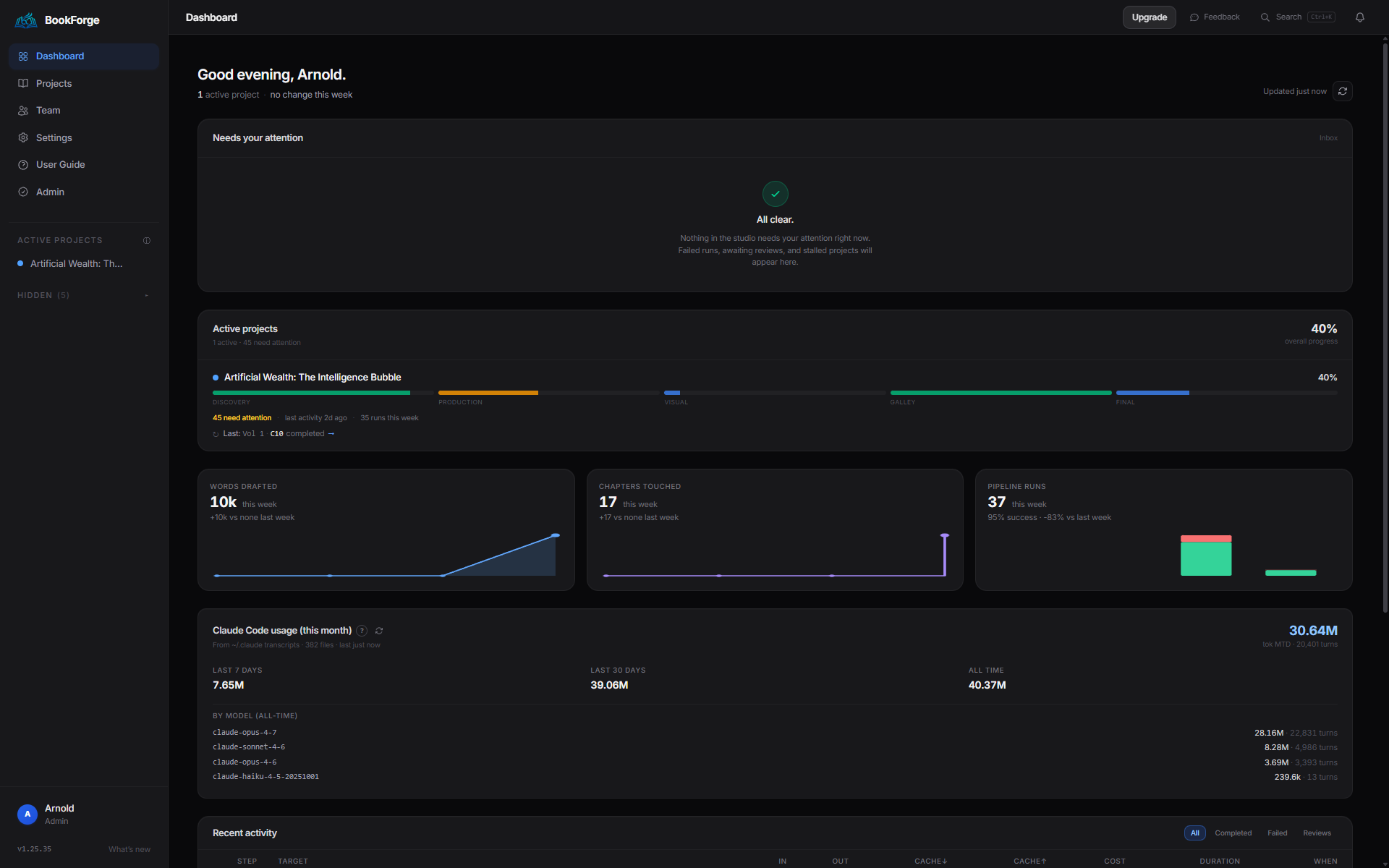
01 Dashboard — your editorial command center. One project highlighted; cross-pipeline progress bars, weekly metrics, Claude Code usage broken down by model.
BookForge desktop app dashboard with the 'Artificial Wealth: The Intelligence Bubble' project at 40% progress. Colored pipeline-phase bars for Discovery, Production, Visual, Galley, Final. Weekly metrics: Words drafted 10k, Chapters touched 17, Pipeline runs 37 at 95% success. Claude Code usage 30.62M tokens this month, broken down by model (opus-4-7, sonnet-4-6, opus-4-6, haiku-4-5).
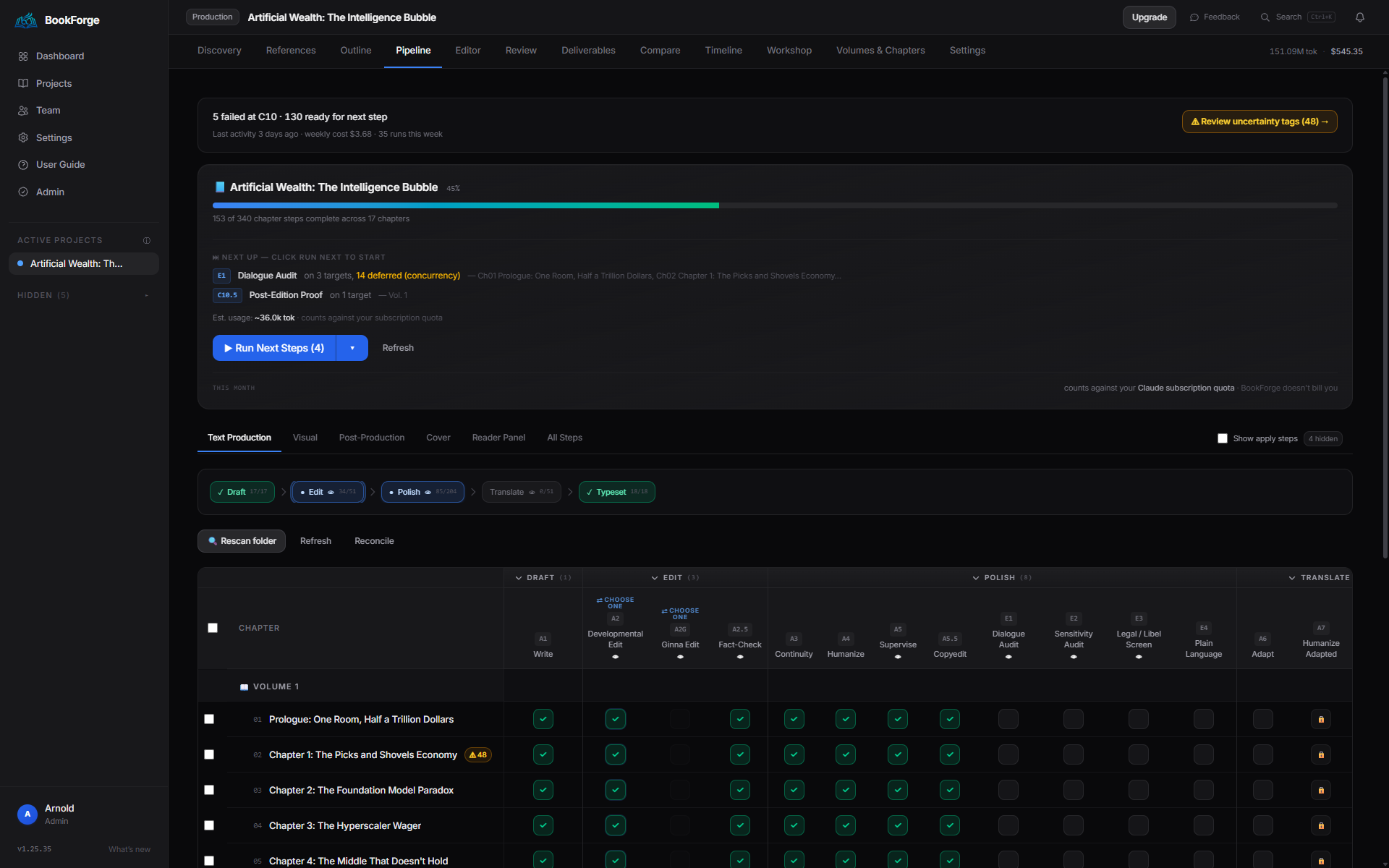
02 Pipeline Matrix — chapters as rows, production steps as columns. Status dots show what's done, running, awaiting review, or blocked. Click any cell for step detail.
BookForge Pipeline Matrix showing the Artificial Wealth project. Header indicates 5 failed at step C10, 130 ready for the next step. A 'Review uncertainty tags' callout with 45 outstanding. 'Run Next Steps (4)' primary action. Below: a grid of chapters (Prologue, Chapter 1, Chapter 2, Chapter 3, Chapter 4) as rows against pipeline steps (Developmental Edit, Fact-check, Continuity, Humanize, Supervise, Copyedit, etc.) as columns, with colored status dots in each cell.
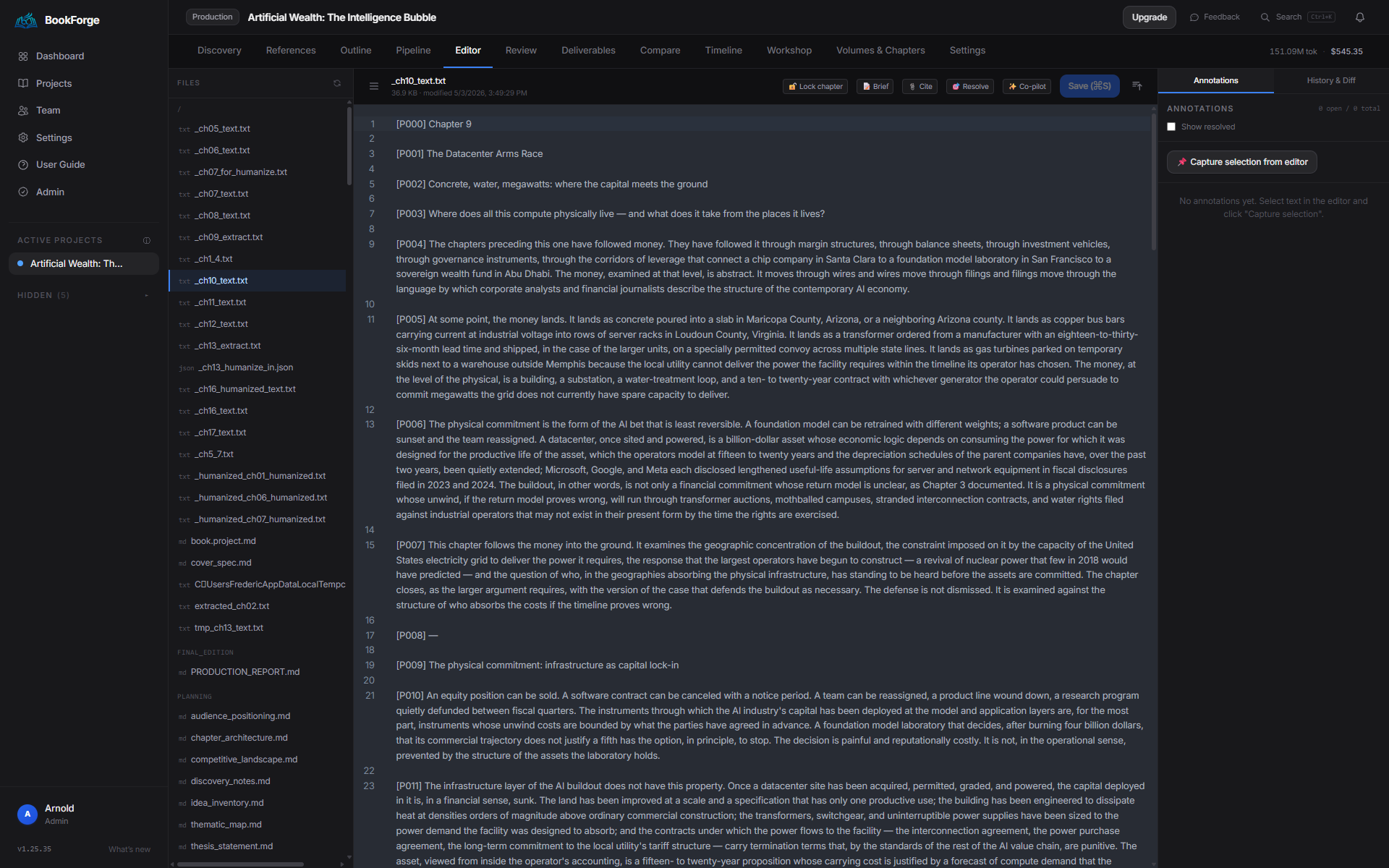
03 Editor — real chapter prose, file tree on the left, annotation pane on the right. Every chapter draft hashed, versioned, traceable.
BookForge Editor open on chapter 10 (_ch10_text.txt). Left pane shows the project file tree with chapter files (_ch01_text.txt through _ch17_text.txt, humanized variants, extraction files, planning notes). Center pane shows real chapter prose: 'Chapter X — The Datacenter Arms Race — Concrete, water, megawatts: where the capital meets the ground' with multiple paragraphs of book text about hyperscalers and AI infrastructure. Right pane shows the Annotations panel with a 'Capture selection from editor' affordance.
Provenance

Your manuscripts never leave your machine.

BookForge runs entirely on your computer. The desktop app spawns Claude as a subprocess against your account; manuscripts, drafts, and review reports stay on disk. Every artifact is SHA-256 hashed and registered in a local SQLite database — so every line of the final book traces back to the prompt, the model version, the reviewer's decision, and the exact timestamp.

No telemetry, no cloud uploads of your work, no third-party intermediary. Read the privacy notice.